Bamboo flooring installation and strand woven bamboo flooring installation is similar to the installation of most other hardwood floors. In many instances Eco-Logic Bamboo flooring installation requires less installation skill, as it is a pre-finished product and therefore does not require sanding and sealing. It is already tongue and grooved, or is installed via a easy to use click locking system and has the option of a factory installed underlay applied directly to the flooring plank.
This bamboo flooring installation guide is provided as a courtesy and for information purposes only. We recommend the use of professional installers for best results.
Bamboo flooring installation – acclimatization
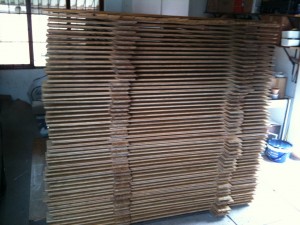
Bamboo flooring installation – acclimitization
Prior to delivery of the bamboo flooring to the job site, the building should be closed in with outside windows and doors in place. All concrete, masonry and framing should be thoroughly dry. In warm months the building must be well ventilated; during winter months heating should be maintained near occupancy levels at least five days before the flooring is delivered.
The bamboo flooring planks should be placed in the room where it will be installed and removed from all packaging. The flooring planks should be stacked so that they get maximum exposure to the air.
For example, the planks can be stacked in a grid pattern, with the first layer laid out with 5-8 cm of space between each plank, then stack the next layer on top of the first layer perpendicular to the first layer, also 5-8 cm apart. The flooring can be stacked in this way up to 90-120 cm high.
The flooring should be stacked top-to-top and bottom-to-bottom to avoid unnecessary wear on the finish. Solid bamboo flooring planks must remain like this for at least five days before being installed. Strand woven bamboo flooring planks will take longer to acclimatize, allow for 7 to 21 days at least.
Bamboo flooring installation – complimentary products
The following products are proven for a bamboo flooring installation(dependent of chosen installation method):
- Elastilon Basic 3 mm
- Sika Sikabond T52
- Bostik Durabond D332
- Rubberlay RL200E
- Damp proofing membrane (DPM) – 250 micron thick, must be SABS approved.
- Sika or other glue gun or notched trowel
- Bostik D250 or D261 Moisture Vapour Barrier
- Sika SikaFloor 156ZA Moisture Vapour Barrier
Bamboo flooring installation methods
Oriental Bamboo suggests the Elastilon™ and Sika™ range of products for bamboo flooring installation. Please follow the manufacturers guidelines when applying these products.
The following are three of the most common methods of installing a bamboo floor:
Bamboo flooring installation using the floated floor method
Bamboo flooring installation on concrete sub-floors, solid wood or bamboo flooring must not be installed if the moisture content of the concrete screed exceeds five percent (5%). If the moisture content is higher than 5%, corrective measures should be made before bamboo floor installation. The flooring installer should document all screed moisture levels before installing the bamboo flooring planks. The screed must be of a good quality and applied according to the SABS standards.
Before you start with your bamboo flooring installation, ensure;
- The concrete should be checked for flatness and low spots should be filled to a minimum of 5 mm in a 3 m radius or 3 mm in a 1.85 m radius. High spots should be ground down to level.
- Ensure that the screed has properly bonded to the concrete below and is of a good consistency.
- The surface must be free of all dirt, debris, oil, and solvents.
- Very important:- an expansion gap of 12 – 15 mm must be left around the perimeter of the floor.
If you are using the Elastilon based bamboo flooring installation method, please follow these guidelines.
- If you are using DPM as a moisture barrier, a DPM layer is laid over the entire sub-floor. Ensure an overlap of 300 mm between sheets.
- If you have chosen to use a paint-on vapour barrier (recommended), this needs to be applied to the sub-floor and fully cured before continuing with the installation.
- The underlay is laid on top of the moisture barrier layer without any overlap. If you are using Rubberlay as your underlay product, the coarse side must face down. The bamboo planks rest on top of the underlay.
- The glue is applied into the groove of the bamboo plank using a glue gun, before inserting the tongue of the adjacent plank.
- Tap the planks firmly together using a rubber mallet to ensure the planks are tightly fitted together.
- Excess glue can wiped off using Mineral Turpentine, whilst the glue is still wet. If the glue has dried a specialised cleaning product will be required.
- The planks will require strapping together with tape until the glue has dried.
When using our unique Eco-Logic Bamboo Click-Lock + Underlay flooring planks, none of the gluing steps nor the need for an underlay above apply, simply click the planks together in the desired pattern. The moisture vapour barrier is a CRITICAL aspect of a successful installation.
Bamboo flooring installation using the “glue down” method
The glue down bamboo flooring installation method yields optimal results for minimal floor movement and superior acoustics. This method is NOT recommended for strand woven flooring installations.
On concrete sub-floors, bamboo flooring must not be installed if the moisture content of the concrete screed exceeds five percent (5%). If the moisture content is higher than 5%, corrective measures should be made before installation of the floor. The flooring installer should document all screed moisture levels before installing the bamboo flooring planks. The screed must be of a good quality and applied according to the SABS standard.
Before you start with your bamboo flooring installation, ensure;
- The concrete should be checked for flatness and low spots should be filled to a minimum of 5 mm in a 3 m radius or 3 mm in a 1.85 m radius. High spots should be ground down to level.
- Ensure that the screed has properly bonded to the concrete below and is of a good consistency.
- The surface must be free of all dirt, debris, oil, and solvents.
- Very important:- an expansion gap of between 12 – 15 mm must be left around the perimeter of the floor.
Moisture Vapour Barrier

Image via Wikipedia
It is essential that the moisture content of the entire sub-floor be tested with a hygrometer and that the moisture level be below 6% (six). If the moisture level is below 3%, the application of a Moisture Vapour Barrier is not essential (but recommended). Above 6% and the moisture barrier will be ineffective and wooden flooring should not be laid. If the moisture content is higher than 5%, corrective measures should be made before installation of the floor. The flooring installer should document all sub-floor moisture levels before installing the bamboo flooring planks.
Please follow the manufacturers guidelines when applying a moisture vapour barrier product – this is essential to ensure the proper moisture protection and to avoid moisture problems with the floor. As a guideline, depending on the quality of the screed, a litre of Sikafloor 156ZA will cover between 3 – 5 square meters. An average of 4 square meters per liter is used.
Glue down bamboo flooring installation
We do not recommend this installation method for strand woven bamboo flooring.
There are two types of glue applications:
Full surface bond – for bamboo flooring installations where the planks are greater than 15 mm in thickness. A full surface bond also gives added sound deadening qualities. This requires 1.2 litres per square meter (sqm). Please refer to manufacturers instructions when applying the glue.
Bead application – for bamboo flooring installations where the planks are less than 15 mm thick, triangular beads of 10 mm high by 8 mm wide are drawn 150 mm apart, perpendicular to the floor plank. This is done using the Sika sausage gun fitted with the correct nozzle. One 600 ml sausage covers one square meter. Please refer to manufacturers instructions when applying the glue.
Nail down bamboo flooring installation
The nail down bamboo flooring installation method is not recommended for strand woven bamboo flooring planks as the density of the planks is too high.
- Planks are to be laid square with the room and parallel to its longest dimension. You can achieve this by positioning with a chalk line, leaving a 6 mm expansion space from base plate or wall.
- Ensure starter rows are firmly in place by wedging or face nailing.
- Once initial rows are secure, second and further courses can be blind nailed directly above tongue at a 45 to 50 degree angle to the face.
- Fasteners need to be spaced at 250 mm to 300 mm intervals, with a minimum of two fasteners per piece.
- Nails or cleats should not be placed closer than 150 mm from the end of planks to prevent splitting.
Special considerations for Bamboo Decking Installation
Decking planks require acclimatisation before installation, please use the same guidelines described elsewhere in this document.
Please ensure the cut ends are also sealed before installation.
After an installation, it is suggested that the deck be sealed again within a maximum of three months. Thereafter, the requirement for sealing depends on the severity of the weather, to which the deck is exposed. Typically, sealing can be performed annually, but harsher conditions may require more regular sealing.
As bamboo decking planks are extremely dense, oil is not an ideal finishing product. We therefore suggest you consider finishing products specifically designed for dense/low porosity hard woods. Examples of these products are (please follow manufacturers application instructions when applying):
- Alcolin Exterior Factor 30 – exterior waterproof wood sealer
- Timberlife Satinwood 28 Base – hardwood with low porosity
- FloodSA Spa-N-Deck + Powerlift stripper
As with other natural woods exposed to outdoor weather conditions, it is recommended that an expansion gap be left between the planks to allow for normal movement due to weather conditions.
Bamboo decking planks, just like any other solid wood decking planks, will expand if submerged in water. It is recommended that the installer ensures the decking planks are installed in such a manner to avoid excessive water pooling around the planks. It is also recommended that the bamboo decking planks be installed in such a way as to allow air to flow freely around the planks in order that the planks may “breathe”.
Raw bamboo decking planks exposed to continual moisture or high humidity conditions are susceptible to mould. We recommend a sealant that contains a mould inhibitor or adding a mould inhibitor to the sealant.
Radiant Heat / Floating Floor Installation
Bamboo flooring, like all solid wood flooring is a poor conductor of heat, so is not ideally suited to underfloor heating installations.
With radiant heat, the heat source is directly beneath the flooring, so the flooring may gain moisture or dry out faster than a similar floor in a home with a conventional heating system.
Bamboo flooring can be installed over radiant heat as long as you understand how radiant heat will impact the flooring. Ensure the necessary precautions have been taken. Please consult you local underfloor heating specialists BEFORE installing a bamboo floor over underfloor heating.
The following bamboo flooring installation systems can be used successfully over radiant heat: Glue Down; Direct Nail to Sub-floor (nail down) and Floated Floor.
The installer should refer to the recommendations of SAWLFA or the NWFA for specifics involving the installation of hardwood flooring over radiant heating systems. The Radiant Panel Association (www.rpa-info.com) is helpful with information and installers.
What can go wrong with a bamboo flooring installation?
In our experience, 99% of bamboo flooring installationproblems can be attributed to the following:
- The No. 1 top cause of problems are due to the underlying concrete slab not being fully cured (dry) before the flooring was installed. It is essential that the flooring installer ensure that the concrete slab is within the required moisture specifications. This can be achieved using a calibrated hygrometer or using the Calcium Chloride Test method.
- Gaps at outdoor entrances are not sealed against water ingress.
- Expansion gaps are not left around the edges of the installed floor. So there is no room for the floor to expand. Bamboo also expands along the length – this is different to solid timber floors.
- Low quality underlay products are used that compress after a period of use causing “dead spots” in the floor.
- Low quality, too little or no glue is used on T&G flooring planks. So the floor develops gaps between some planks.
- Cleaning staff use sopping wet mops to clean the floor. All that’s needed is a moist squeeze mop.
- Installers skip laying down a moisture vapour barrier onto the cement screed before installing the floor.
- The DPC is missing or damaged on exterior facing walls allowing moisture ingress.
Oriental Sourcing (Pty) Ltd makes no warranty or guarantee as to the quality of the chosen bamboo flooring installer’s workmanship and disclaims all liability for errors in the installation by an installer.
